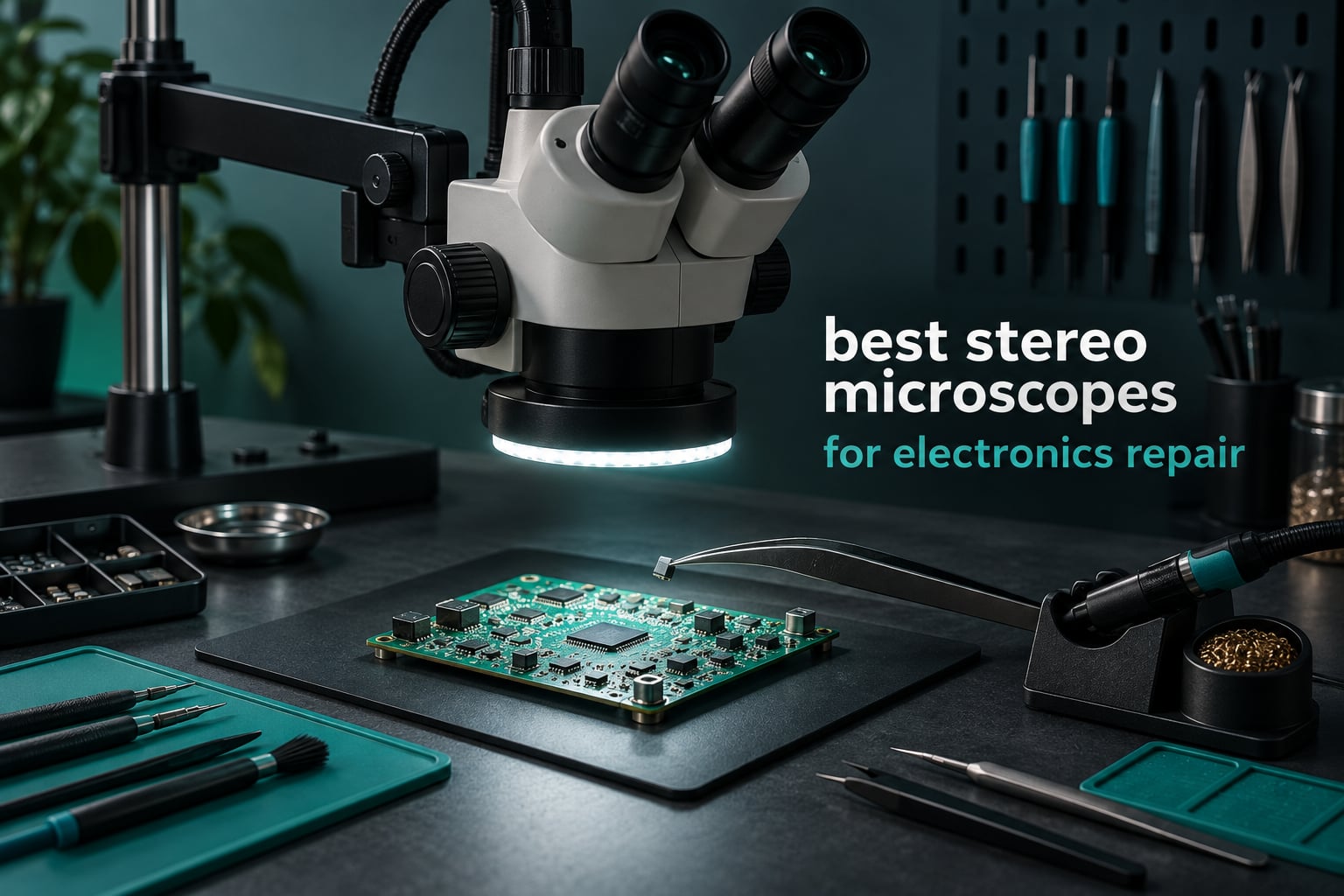
Quick answer: for most electronics repair benches, the best stereo microscope for electronics repair work is a simul-focal binocular or trinocular zoom scope with 7X-45X of usable magnification, a working distance above 100mm, and a ring or dual-gooseneck LED illuminator. Those three specs decide whether you can guide an iron tip or only inspect a joint after the fact.
I have spent more bench hours than I would like to admit staring at solder joints through bad optics, and the pattern is consistent. You do not need 1000X. You do not need a screen. You need depth perception, clearance for your hands, and light that does not hide a bridge.
This roundup covers nine true optical stereo microscopes, from a cordless battery-powered beginner kit to a professional trinocular zoom head on a double-arm boom stand. Every entry is a binocular or trinocular instrument with real glass optics, not a USB camera in a plastic barrel, and I explain where a digital scope still makes more sense near the end.
SMD pads, ball-array rows and hairline cracks all sit below what your unaided eye can resolve at a normal working distance. That is the whole argument for buying one. Below that, here is what separates a scope you will keep for a decade from one you will replace in a year.
The quickest way to cut through the noise: the specs that matter most are working distance, zoom control, head type, lighting, and base stability. Everything else on the box is decoration.
Table of Contents›
- 1Top 3 Stereo Microscopes for Electronics Repair in 2026
- 2AmScope SE306R-PZ
- 3AmScope SM-4TZ-144A
- 4DZQ ZQ-1
- 5All Nine Microscopes Compared Side by Side
- 6Stereo vs Digital Microscope: Which Should You Buy?
- 7Which Magnification Do You Actually Need?
- 81. AmScope SE306R-PZ – The All-Round Starter With Serious Optics
- 9AmScope SE306R-PZ Forward Binocular Stereo Microscope, WF10x and WF20x
- 10Pros
- 11Cons
- 12What 20X and 40X actually look like on a board
- 13Where this scope falls short on a pro bench
- 142. AmScope SE306R-P-LED – The Same Optics Without the Heat
- 15AmScope SE306R-P-LED Cordless LED Stereo Microscope, 20x-40x
- 16Pros
- 17Cons
- 18Best for shared or mobile benches
- 19Why 40X will feel like a ceiling
- 203. SWIFT S41-20 – Boom-Arm Reach With Shadow-Free Lighting
- 21Swift S41-20 Professional Dissecting Binocular Stereo Microscope, WF10x WF20x Eyepieces, 10X 20X Magnification, 1X Objective, LED Lighting, Boom-Arm Stand
- 22Pros
- 23Cons
- 24Why goose-neck lighting beats a ring light for cracks
- 25The real weakness: no zoom and no brightness dial
- 264. AmScope SM-4TZ-144A – The Professional Benchmark
- 27AmScope SM-4TZ-144A Professional Trinocular Stereo Zoom Microscope, WH10x Eyepieces, 3.5X-90X Magnification, 0.7X-4.5X Zoom Objective, Four-Zone LED Ring Light, Double-Arm Boom Stand, 110V-240V
- 28Pros
- 29Cons
- 30When a trinocular head actually pays for itself
- 31Where the bulk bites
- 325. DZQ ZQ-1 – The Longest Listed Working Distance
- 33DZQ ZQ-1 Multi-Directional Microscope 7X-45X Magnification 0.5X Barlow Lens
- 34Pros
- 35Cons
- 36Working distance is the spec that decides everything
- 37Repositioning it is awkward
- 386. SWIFT Trinocular Zoom with 56-LED Ring – Compact Full-Featured Scope
- 39SWIFT Trinocular Stereo Zoom Microscope with 56-Bulb LED Ring Light,3.5X-90X Magnification,WF10X Eyepieces,0.7X-4.5X Zoom Objective, 0.5X 2.0X Additional Objectives,Table Pillar Stand
- 40Pros
- 41Cons
- 42Trinocular capability on a small footprint
- 43Less long-term history than the AmScope models
- 447. ZTEEERS Trinocular Zoom – Professional Features on a Heavy Steel Base
- 45ZTEEERS Professional Trinocular Stereo Zoom Microscope, 3.5X-90X Magnification,WF10X Eyepieces, 0.7X-4.5X Zoom,0.5X & 2.0X Auxiliary Lens, Double-Arm Boom Stand, 56S LED Ring Light,Two adapters
- 46Pros
- 47Cons
- 48Built for filming the work
- 49Read this before buying: size and support
- 508. AOMEKIE XWJ-40X – A Complete Starter Kit, Not a Repair Tool
- 51Aomekie® Microscope 20X 50X with 10Pcs Slides Insect Specimen Stereo Microscope with WF eyepieces LED Light Source Portable Stereoscope 12Pcs Mineral specimens
- 52Pros
- 53Cons
- 54What you get in the box
- 55Why the narrow field stops repair work cold
- 569. SWIFT S7 Trinocular – Long Reach With a Camera Port
- 57SWIFT S7 7X-45X Trinocular Stereo Microscope with Wide-Field 10X Eyepieces,0.7X-4.5X Zoom Objective Lens, Single-Arm Boom Stand, and 56-Bulb LED Ring Light
- 58Pros
- 59Cons
- 60Reach versus footprint, honestly assessed
- 61Buy it for the zoom, not the magnification number
- 62Buying Guide: Working Distance, Head Type, and Lighting
- 63What to Avoid When Buying a Repair Microscope
- 64Fitting a Microscope on a Small Bench
- 65AmScope Model Numbers, Decoded
- 66Frequently Asked Questions
- 67What is the best microscope for electronic repair?
- 68Which stereo microscope is the best?
- 69What are the best digital microscopes for soldering?
- 70What are the downsides of using a stereomicroscope?
- 71What digital microscope is best for electronic repair?
- 72What is the best microscope for mobile repairing?
- 73What magnification is needed for PCB inspection?
- 74The Verdict
Top 3 Stereo Microscopes for Electronics Repair in 2026

AmScope SE306R-PZ
- 20X-40X-80X magnification
- Halogen top and base lights
- All-metal pillar stand

AmScope SM-4TZ-144A
- 3.5X-90X zoom objective
- Four-zone 144-LED ring light
- Double-arm boom stand

DZQ ZQ-1
- 7X-45X continuous zoom
- 95-300mm working distance
- Dimmable 60-LED ring
As an Amazon Associate we earn from qualifying purchases. CERTAIN CONTENT THAT APPEARS ON THIS SITE COMES FROM AMAZON. THIS CONTENT IS PROVIDED 'AS IS' AND IS SUBJECT TO CHANGE OR REMOVAL AT ANY TIME.
All Nine Microscopes Compared Side by Side
| # | Product | Price |
|---|---|---|
| 1 |
AmScope SE306R-PZ
|
Check Latest Price |
| 2 |
 AmScope SE306R-P-LED
|
Check Latest Price |
| 3 |
 SWIFT S41-20
|
Check Latest Price |
| 4 |
AmScope SM-4TZ-144A
|
Check Latest Price |
| 5 |
DZQ ZQ-1
|
Check Latest Price |
| 6 |
 SWIFT Trinocular Zoom
|
Check Latest Price |
| 7 |
 ZTEEERS Trinocular Zoom
|
Check Latest Price |
| 8 |
 AOMEKIE XWJ-40X
|
Check Latest Price |
| 9 |
 SWIFT S7 Trinocular
|
Check Latest Price |
As an Amazon Associate we earn from qualifying purchases, at no additional cost to you. CERTAIN CONTENT THAT APPEARS ON THIS SITE COMES FROM AMAZON. THIS CONTENT IS PROVIDED 'AS IS' AND IS SUBJECT TO CHANGE OR REMOVAL AT ANY TIME.
Stereo vs Digital Microscope: Which Should You Buy?
This is the single most repeated question on repair forums, and the answer from people who own both is remarkably consistent: a stereo scope wins for soldering, a digital scope wins for filming.
A stereo microscope sends a separate optical path to each eye, so you get a genuine three-dimensional image with real depth perception. Your hands and your eyes stay in the same visual space, and that is what lets you judge iron tip height without thinking about it.
On a digital scope, the image lives on a screen a few inches away. The depth cue is gone, and the camera introduces a small delay that your hand learns to fight. People who switched from digital to optical describe it as the moment soldering stopped being guesswork. One recurring complaint in the r/soldering threads is simply that you cannot solder under a screen without hesitating over every joint.
Digital scopes do win in three specific situations. They document work for free through screen capture, they let you show a defect to a client or a forum, and their small flex-arm footprints fit benches where a boom stand will not go. If your repairs are phone and laptop boards that live in your hand, a digital scope is a reasonable first tool.
One warning about digital marketing you should ignore completely: advertised magnification above about 50X on a USB microscope is not real resolution. It is digital upscaling of a 1080p sensor. A real optical stereo scope shows you 7X-45X of genuine detail and nothing beyond it, which is exactly the range electronics work lives in.
Which Magnification Do You Actually Need?
Match your magnification to the smallest component you expect to touch, not to the biggest number on the listing.
At 7X-10X you can see an entire quarter of a phone logic board, which is the right power for orientation, connector removal, and checking for obvious contamination. This is the low end you want to live in, because a 0.5X auxiliary objective widens the field and reduces eye strain.
At 20X-30X you handle the standard surface-mount sizes: 0805 and 0603 parts, larger IC packages, and through-hole joints. Most routine microsoldering happens in this band, and it is where a good scope earns its keep.
At 40X-45X you reach 0402 and 0201 parts, fine-pitch QFN leads, and the ball rows on a BGA package during reballing. The field of view gets tight and depth of field gets shallow, so you are working almost touch-sensitive close to the board.
Going beyond 45X on a 10X eyepiece scope only narrows the field and thins the depth of field. The extra 2.0X Barlow lenses included with several of these scopes are useful for documenting a defect, not for guiding a tip.
One practical tip: the useful range is set by the eyepiece, the objective, and your own vision. If you wear glasses, budget for head movement. If you do not, the 45-degree head inclination on most of these scopes still keeps your neck out of a bad position over a long session.
1. AmScope SE306R-PZ – The All-Round Starter With Serious Optics
AmScope SE306R-PZ Forward Binocular Stereo Microscope, WF10x and WF20x
- 20X-40X-80X stereo
- 2X and 4X objectives
- Halogen top and base lights
Pros
- Sharp chromatic-aberration-free glass optics
- Solid all-metal frame that resists tipping
- Switchable incident and transmitted lighting
- Covers most hobby and light repair inspection
Cons
- Halogen housing runs hot enough to burn fingers
- No continuous zoom between steps
- Narrow field of view and thin depth of field at 80X
As an Amazon Associate we earn from qualifying purchases, at no additional cost to you. CERTAIN CONTENT THAT APPEARS ON THIS SITE COMES FROM AMAZON. THIS CONTENT IS PROVIDED 'AS IS' AND IS SUBJECT TO CHANGE OR REMOVAL AT ANY TIME.
The SE306R-PZ is the scope I recommend first for almost anyone starting out in board repair. The optics are honest widefield glass with no visible fringing at the top of its range, which is more than you can say for most instruments at this level.
It is a pillar stand rather than a boom arm, so the head sits over a fixed base plate and you move the board instead of the head. On a crowded bench that is a compromise, but the all-metal framework means it does not wobble when you touch the focus knob, and the 16 ounce base keeps the whole thing planted.
Three magnification steps at 20X, 40X and 80X come from a 2X and 4X objective paired with the supplied eyepieces. That is enough to inspect a 0603 joint comfortably at 40X and to check a fine IC pin row at 80X.
The one genuine complaint that comes up repeatedly is heat. The halogen illumination housing sits close to the stage and gets uncomfortably hot, and a few owners reported the top lamp flickering at high brightness settings. The optics themselves rarely draw complaints; if you work on heat-sensitive parts, move the lamp housing further out or accept a cooler LED alternative.
What 20X and 40X actually look like on a board
At 20X the field covers a working area of roughly a square inch, which is about right for a single IC and its surrounding components. You can see pad condition, solder sheen, and obvious bridging without moving the board.
At 80X the field shrinks to a few millimetres. That is where you inspect a single joint, check a lifted pad corner, or read a laser marking on a tiny part. It is inspection magnification, not working magnification.
Where this scope falls short on a pro bench
Stepped magnification means you cannot frame a job continuously. If you are chasing a hairline crack or working your way along a row of pads, you constantly flip the objective and re-focus.
The pillar base also means no reach. Pulling a laptop motherboard toward you to find a comfortable position is a bigger interruption than swinging a boom arm out of the way would be.
As an Amazon Associate we earn from qualifying purchases, at no additional cost to you. CERTAIN CONTENT THAT APPEARS ON THIS SITE COMES FROM AMAZON. THIS CONTENT IS PROVIDED 'AS IS' AND IS SUBJECT TO CHANGE OR REMOVAL AT ANY TIME.
2. AmScope SE306R-P-LED – The Same Optics Without the Heat
AmScope SE306R-P-LED Cordless LED Stereo Microscope, 20x-40x
- 20X and 40X stereo
- LED incident and transmitted light
- Battery powered, cordless
Pros
- LED illumination runs cool and never burns a component
- Cordless so you can carry it to a client bench
- Sharp widefield glass at both power settings
- Durable metal framework
Cons
- Only two fixed magnification steps
- 40X ceiling is low for fine-pitch work
- Narrow field of view limits context around the joint
As an Amazon Associate we earn from qualifying purchases, at no additional cost to you. CERTAIN CONTENT THAT APPEARS ON THIS SITE COMES FROM AMAZON. THIS CONTENT IS PROVIDED 'AS IS' AND IS SUBJECT TO CHANGE OR REMOVAL AT ANY TIME.
If the halogen lamp on the previous scope worries you, this is the same AmScope platform with LED illumination and a battery instead of a cord. The heat problem disappears entirely, which matters when you are parked over a board for an hour with a hot iron in the other hand.
Cordless operation is the quiet superpower here. You can carry the whole thing to a customer’s kitchen table, to a car, or to a shared workbench without hunting for an outlet, and the 3.3 pound weight makes it genuinely portable.
Optically you get the same widefield glass and the same forward binocular head at a 45-degree inclination, which keeps your neck neutral. Both the incident light from above and the transmitted light from below can be switched independently, and the transmitted base is useful for looking through a component or a display stack.
The compromise is magnification. Twenty and forty times only, with no 80X step and no zoom in between. That covers 0805 and 0603 work and routine connector jobs, but if your work includes fine-pitch QFN or BGA inspection you will outgrow it quickly.
Best for shared or mobile benches
Two AA batteries and a light chassis make this one of the easiest scopes here to move between work surfaces. Repair techs working across multiple sites, or anyone who does not have a dedicated bench, will feel that difference on every job.
The 45-degree inclination also means you are not bending over a horizontal eyepiece, which is where neck and back discomfort usually starts on a long session.
Why 40X will feel like a ceiling
Forty times shows you a 0402 part and a clean joint, but it does not give you the resolution to read a fine-pitch QFN lead row or count individual balls on a BGA. Those jobs want 45X of continuous optical zoom plus a 2.0X auxiliary objective.
Narrow field of view compounds this. At 40X you see the joint and almost nothing else, so orientation costs you extra time.
As an Amazon Associate we earn from qualifying purchases, at no additional cost to you. CERTAIN CONTENT THAT APPEARS ON THIS SITE COMES FROM AMAZON. THIS CONTENT IS PROVIDED 'AS IS' AND IS SUBJECT TO CHANGE OR REMOVAL AT ANY TIME.
3. SWIFT S41-20 – Boom-Arm Reach With Shadow-Free Lighting
Swift S41-20 Professional Dissecting Binocular Stereo Microscope, WF10x WF20x Eyepieces, 10X 20X Magnification, 1X Objective, LED Lighting, Boom-Arm Stand
- 10X-20X with WF10x and WF20x eyepieces
- 12-inch swinging boom arm
- Dual goose-neck LED lights
Pros
- Two flexible goose-neck LEDs light PCB surfaces without shadows
- Long boom arm clears large work areas
- Heavy metal base and cast optical head feel industrial
- Interchangeable eyepieces give two working powers
Cons
- No continuous zoom
- Field of view at 10X is narrow for close work
- LED brightness has no adjustment
- Base can be marginal when the arm is fully extended
As an Amazon Associate we earn from qualifying purchases, at no additional cost to you. CERTAIN CONTENT THAT APPEARS ON THIS SITE COMES FROM AMAZON. THIS CONTENT IS PROVIDED 'AS IS' AND IS SUBJECT TO CHANGE OR REMOVAL AT ANY TIME.
The S41-20 solves a problem the pillar scopes cannot: reach. A 12-inch swinging boom arm lets you move the head over a large motherboard, angle it around a tall component, and pull it out of the way while you handle the board.
The lighting is the reason to pick it. Two independent flexible goose-neck LED arms can be aimed from opposite sides to rake light across a solder joint, which reveals surface texture and cracks that a flat ring light washes out. On a non-reflective board surface, that is genuinely useful.
Optically you get 10X and 20X through interchangeable widefield eyepieces on a 1X achromatic objective, with adjustable interpupillary distance and a fixed 45-degree inclination. The cast head and metal base give it a weight and rigidity that plastic-bodied kits cannot match.
It is also camera-ready: the head accepts a digital USB camera sold separately, so if you want stills for documentation you can add one without changing scopes. What you cannot do here is zoom, which is the main limitation for anyone doing fine-pitch work.
Why goose-neck lighting beats a ring light for cracks
A ring light shines straight down. It is even and shadow-free, but it flattens a surface and hides texture. Angled side light casts small shadows from every scratch, pad edge, and hairline crack.
If your work involves finding a fracture in a board or checking a joint for micro-cracking, angled light is the better tool. If your work is general assembly and inspection, a ring light is faster.
The real weakness: no zoom and no brightness dial
Two fixed eyepiece powers means swapping lenses to change magnification, which interrupts the work. Many owners add a 0.5X eyepiece or objective to get lower power, which is a good fix.
There is also no brightness control, so you are stuck with the output the goosenecks give you. And reviewers note the base can feel marginal with the arm at full extension, so keep the head close to the base when you are fine-tuning.
As an Amazon Associate we earn from qualifying purchases, at no additional cost to you. CERTAIN CONTENT THAT APPEARS ON THIS SITE COMES FROM AMAZON. THIS CONTENT IS PROVIDED 'AS IS' AND IS SUBJECT TO CHANGE OR REMOVAL AT ANY TIME.
4. AmScope SM-4TZ-144A – The Professional Benchmark
AmScope SM-4TZ-144A Professional Trinocular Stereo Zoom Microscope, WH10x Eyepieces, 3.5X-90X Magnification, 0.7X-4.5X Zoom Objective, Four-Zone LED Ring Light, Double-Arm Boom Stand, 110V-240V
- 3.5X-90X total magnification
- 0.7X-4.5X zoom objective
- Four-zone 144-LED ring light
Pros
- Continuous 0.7X-4.5X zoom covers PCB rework through fine detail
- Four-zone ring light lets you control intensity and direction independently
- Double-arm boom gives 20-inch reach for large boards
- Trinocular head rotates 360 degrees for camera work
Cons
- Bulky stand demands a dedicated work surface
- Higher commitment than a binocular scope
- Listed weight figure is not reliable
As an Amazon Associate we earn from qualifying purchases, at no additional cost to you. CERTAIN CONTENT THAT APPEARS ON THIS SITE COMES FROM AMAZON. THIS CONTENT IS PROVIDED 'AS IS' AND IS SUBJECT TO CHANGE OR REMOVAL AT ANY TIME.
This is the configuration most repair professionals end up with, and the reason is the zoom objective. A 0.7X to 4.5X continuous range means you sweep from 7X to 45X without stopping to change anything, and with the included 0.5X and 2.0X auxiliary lenses you extend that to 3.5X-90X.
The four-zone LED ring light is the piece most people underestimate. The 144 bulbs are split into four independently controlled zones, so you can brighten the top two and dim the bottom two to kill the specular glare that makes a shiny IC package or a wet flux blob unreadable.
Working distance is the headline spec for board work, and the double-arm boom stand with 20-inch arms and a 17-inch pillar is what creates it. You can fit both hands, an iron, tweezers, and a brush under the objective. The head moves on three axes and holds position without sag.
The trinocular head carries 10X super-widefield eyepieces with adjustable interpupillary distance, a fixed 45-degree inclination, and 360-degree rotation. The vertical third port takes a camera adapter, so you can document a joint or stream a repair without giving up the binocular view. The 110V-240V supply means it works on either side of a border.
When a trinocular head actually pays for itself
The third port pays off the first time you need a picture rather than a view. Before-work condition photos, after-work proof for a customer, a forum post asking why a board will not boot, a video for documentation.
Because the port is vertical, you can attach a camera and keep both eyes in the eyepieces simultaneously. You are not swapping back and forth between looking and filming.
Where the bulk bites
This is a big instrument. The double-arm stand needs a dedicated surface, and on a shared bench it will crowd everything else. The listed weight figure for the listing is clearly wrong, so plan on the stand, not the number.
It is also a step up in class over a binocular scope. If you solder two or three times a month on through-hole or large connectors, you probably do not need continuous optical zoom yet.
As an Amazon Associate we earn from qualifying purchases, at no additional cost to you. CERTAIN CONTENT THAT APPEARS ON THIS SITE COMES FROM AMAZON. THIS CONTENT IS PROVIDED 'AS IS' AND IS SUBJECT TO CHANGE OR REMOVAL AT ANY TIME.
5. DZQ ZQ-1 – The Longest Listed Working Distance
DZQ ZQ-1 Multi-Directional Microscope 7X-45X Magnification 0.5X Barlow Lens
- 7X-45X continuous zoom
- 95-300mm working distance
- 0.5X Barlow lens included
Pros
- 95-300mm working distance leaves real room for tools
- Dim-able ring light gives even shadow-free illumination
- Smooth continuous 7X-45X zoom with mechanical focus
- Spring-mounted arm and adjustable headrest cut fatigue
Cons
- Very heavy and awkward to reposition
- 33-degree field of view is narrower than typical
- Near-24 inch footprint is demanding
- 45X ceiling without the 0.5X lens
As an Amazon Associate we earn from qualifying purchases, at no additional cost to you. CERTAIN CONTENT THAT APPEARS ON THIS SITE COMES FROM AMAZON. THIS CONTENT IS PROVIDED 'AS IS' AND IS SUBJECT TO CHANGE OR REMOVAL AT ANY TIME.
The ZQ-1 has the longest listed working distance range in this roundup. Its 95-300mm range is adjustable, and that puts a genuinely large volume of space between the objective and the board, which is what solder-punishment and hot air rework need.
Because the working distance varies, you can set it wide when you are positioning tweezers under the head and tighten it up when you are inspecting a joint. Very few binocular scopes in this class give you that control.
Zoom is continuous from 7X to 45X and the mechanics are smooth, and the included 0.5X Barlow lens lets you back off further for a wide view of a whole board section. The 60-LED ring light dims from full to zero, so you can drop the intensity when you are looking at a glossy epoxy-coated package that is throwing reflections back at you.
Two details matter for long sessions. The spring-mounted support and adjustable headrest let you set the head at your eye height rather than bending down to it, and a wide field of view keeps the whole board area in view when you want orientation.
Working distance is the spec that decides everything
A soldering iron tip held at 30 degrees has a physical length of several centimetres. If your working distance is under about 80mm you will be steering the iron around the objective, and you will bump it.
With 95-300mm you can get both hands and both tools under the head and still see the joint clearly. For anything involving hot air rework or mechanical work alongside soldering, that clearance is what you are paying for.
Repositioning it is awkward
The weight on this base is substantial, and the listed 24 by 17 inch footprint is larger than most small benches. Reviewers consistently single out the difficulty of moving it between work surfaces as the main drawback.
The 33-degree field of view is also narrower than the 45 degrees most stereo heads deliver, so orientation takes a little more scanning at low power.
As an Amazon Associate we earn from qualifying purchases, at no additional cost to you. CERTAIN CONTENT THAT APPEARS ON THIS SITE COMES FROM AMAZON. THIS CONTENT IS PROVIDED 'AS IS' AND IS SUBJECT TO CHANGE OR REMOVAL AT ANY TIME.
6. SWIFT Trinocular Zoom with 56-LED Ring – Compact Full-Featured Scope
SWIFT Trinocular Stereo Zoom Microscope with 56-Bulb LED Ring Light,3.5X-90X Magnification,WF10X Eyepieces,0.7X-4.5X Zoom Objective, 0.5X 2.0X Additional Objectives,Table Pillar Stand
- 3.5X-90X with 0.5X and 2.0X objectives
- 56-bulb LED ring light
- 100mm working distance
Pros
- Continuous 0.7X-4.5X zoom plus auxiliary objectives
- 56-bulb ring light is bright and cool enough for sensitive parts
- Trinocular head accepts a camera for documentation
- Table pillar footprint keeps a full feature set compact
Cons
- Pillar base cannot reach across a large board
- Only 46 reviews means limited long-term data
- Ring light brightness control is not detailed
As an Amazon Associate we earn from qualifying purchases, at no additional cost to you. CERTAIN CONTENT THAT APPEARS ON THIS SITE COMES FROM AMAZON. THIS CONTENT IS PROVIDED 'AS IS' AND IS SUBJECT TO CHANGE OR REMOVAL AT ANY TIME.
This is the scope for someone who wants a trinocular head and a proper zoom objective but does not have the bench for a boom stand. A table pillar footprint keeps it compact, and the optics cover the same 3.5X-90X range as far larger instruments.
The 100mm working distance is on the lower end of what we would want for heavy rework, but it is still enough to get an iron tip and a pair of tweezers under the head for standard connector and SMD work on phone and laptop boards.
The 56-bulb LED ring light is bright, shadow-free, and cool enough that it will not warm a heat-sensitive part, which is a real improvement over halogen illumination. The 45-degree trinocular head rotates through 360 degrees and is designed so eyeglass wearers can still get a full field without pressing their lenses against the eyecups.
The vertical trinocular port doubles as an extra eyepiece or a camera port, and the 0.5X and 2.0X auxiliary objectives expand the range out to 3.5X-90X for close inspection or wide context.
Trinocular capability on a small footprint
Most trinocular heads come attached to boom stands with large footprints. Here you get the third port on a pillar base, so you can add a camera for documentation and still keep the scope near the back corner of a modest bench.
If your work is phone and laptop boards rather than full-size motherboards, a pillar base is not really a compromise. You hold the board and move it, not the head.
Less long-term history than the AmScope models
With 46 reviews on record, there is simply less data about how these hold up over years. The AmScope entries in this roundup have two to three times the review history, which is worth something when you are buying a tool you expect to keep.
Reach is the other limit. There is no way to swing the head aside when you need to get both hands under a large board.
As an Amazon Associate we earn from qualifying purchases, at no additional cost to you. CERTAIN CONTENT THAT APPEARS ON THIS SITE COMES FROM AMAZON. THIS CONTENT IS PROVIDED 'AS IS' AND IS SUBJECT TO CHANGE OR REMOVAL AT ANY TIME.
7. ZTEEERS Trinocular Zoom – Professional Features on a Heavy Steel Base
ZTEEERS Professional Trinocular Stereo Zoom Microscope, 3.5X-90X Magnification,WF10X Eyepieces, 0.7X-4.5X Zoom,0.5X & 2.0X Auxiliary Lens, Double-Arm Boom Stand, 56S LED Ring Light,Two adapters
- 3.5X-90X magnification
- Trinocular head with diopter eyecups
- 18lb steel base with boom arm
Pros
- Feature set and optics comparable to established professional scopes
- 0.5X auxiliary objective gives a wide field for board rework
- Diopter adjustment on both eyecups plus simultaneous camera viewing
- Steel base and ball-bearing arm hold position without sag
Cons
- Very heavy and long
- hard to fit on a small desk
- Confusing instructions
- One-year warranty and no established brand support
As an Amazon Associate we earn from qualifying purchases, at no additional cost to you. CERTAIN CONTENT THAT APPEARS ON THIS SITE COMES FROM AMAZON. THIS CONTENT IS PROVIDED 'AS IS' AND IS SUBJECT TO CHANGE OR REMOVAL AT ANY TIME.
Electronics buyers consistently report this one matching established professional trinocular scopes feature for feature. The 0.7X-4.5X zoom objective plus 0.5X and 2.0X auxiliary lenses give the same 3.5X-90X range, and the trinocular port ships with adapters for digital cameras or electronic eyepieces.
Two details set it apart from cheaper clones. The eyecups have plus or minus 6 diopter adjustment, which genuinely helps if your eyes are not matched to each other, and the optical path lets you keep looking through both eyes while a camera is attached.
The 18 pound solid steel rectangular base and ball-bearing single-arm boom stand hold their position without creeping, which is the failure mode that makes cheap gooseneck stands so annoying to work with. The 56S LED ring light has a dimmer switch, so you can bring the intensity down on reflective components.
The trade-offs are honest ones. It is heavy, it is long, the instructions are unclear enough that owners had to research their own setup, and the warranty is one year against five from the established names.
Built for filming the work
The trinocular port with two included adapters means you can put a camera on this head without buying an extra adapter or a different scope. Combined with the diopter eyecups, it is one of the better filming setups in this roundup.
For someone who documents every repair, whether for a client, a shop record, or a video, the ability to look through the eyepieces and capture at the same time is worth a lot.
Read this before buying: size and support
The listed dimensions are about 19.5 by 11.5 by 19.5 inches assembled, and the base alone is 18 pounds. Plan the bench space before you order, because a heavy stand you have to move every session is a daily annoyance.
Unclear instructions and a one-year warranty are the trade for the specification list. If you want a support structure behind the instrument for the next decade, buy the established-brand scope instead.
As an Amazon Associate we earn from qualifying purchases, at no additional cost to you. CERTAIN CONTENT THAT APPEARS ON THIS SITE COMES FROM AMAZON. THIS CONTENT IS PROVIDED 'AS IS' AND IS SUBJECT TO CHANGE OR REMOVAL AT ANY TIME.
8. AOMEKIE XWJ-40X – A Complete Starter Kit, Not a Repair Tool
Aomekie® Microscope 20X 50X with 10Pcs Slides Insect Specimen Stereo Microscope with WF eyepieces LED Light Source Portable Stereoscope 12Pcs Mineral specimens
- 20X and 50X fixed magnification
- Adjustable 65mm-102mm working range
- Battery LED light source
Pros
- Complete package with slides and specimens in the box
- Cordless battery LED lighting
- Light 872 g body is easy to carry
- Adjustable interpupillary distance suits different users
Cons
- Only two fixed magnification steps with no zoom
- 12-degree field of view and short working range
- Plastic stand is less rigid for precision work
As an Amazon Associate we earn from qualifying purchases, at no additional cost to you. CERTAIN CONTENT THAT APPEARS ON THIS SITE COMES FROM AMAZON. THIS CONTENT IS PROVIDED 'AS IS' AND IS SUBJECT TO CHANGE OR REMOVAL AT ANY TIME.
Let me be direct about where this one fits. This is a teaching and hobby starter kit. It arrives with 10 glass slides, insect specimens and 12 mineral samples, which makes it a genuinely fun first stereo microscope for a student or a curious beginner.
It is not a microsoldering instrument, and the reason is optical rather than financial. The 12-degree field of view is very narrow, and the maximum 50X sits at the very top of the range with no zoom below it. You will be adjusting the working range constantly to see anything at all.
What it does have going for it: cordless two-AA LED lighting, a 65mm to 102mm adjustable working range, an adjustable interpupillary distance of 55mm to 75mm, and a semi-apochromatic objective on a semi-apochromatic class body. The 872 gram weight makes it easy to carry between benches.
If you want to learn what a stereo microscope looks like through, or you occasionally inspect a large component where 20X is enough, it does that job. If your work involves 0402 parts or connector pins, you will replace it within a year.
What you get in the box
Ten glass slides, prepared insect specimens, twelve mineral samples, and a stereo microscope that covers 20X and 50X through WF10X and WF25X eyepieces with a 2X objective. That is a complete package, not a bare instrument.
Two-year warranty coverage is a small plus for a first purchase, and it is one of the few things here that a first-time buyer should not have to think about.
Why the narrow field stops repair work cold
A field of view is how much of the board you see at once. At 12 degrees you see a very small circle, so you lose all orientation and spend your time repositioning the specimen rather than working on it.
Combined with a plastic stand that flexes when you touch the focus knob, and a 50X ceiling with no auxiliary lenses, that is enough to rule this out for board-level repair.
As an Amazon Associate we earn from qualifying purchases, at no additional cost to you. CERTAIN CONTENT THAT APPEARS ON THIS SITE COMES FROM AMAZON. THIS CONTENT IS PROVIDED 'AS IS' AND IS SUBJECT TO CHANGE OR REMOVAL AT ANY TIME.
9. SWIFT S7 Trinocular – Long Reach With a Camera Port
SWIFT S7 7X-45X Trinocular Stereo Microscope with Wide-Field 10X Eyepieces,0.7X-4.5X Zoom Objective Lens, Single-Arm Boom Stand, and 56-Bulb LED Ring Light
- 7X-45X continuous zoom
- 0.7X-4.5X zoom objective
- 56-bulb LED ring light
Pros
- Smooth continuous 7X-45X zoom with diopter eyepieces
- Single-arm boom gives long reach for full-size boards
- 56-bulb ring light is bright and cool for sensitive components
- Trinocular port plus included 0.5X C-mount adapter for imaging
Cons
- Heavy boom base takes substantial bench space
- Only 22 reviews
- so limited long-term data
As an Amazon Associate we earn from qualifying purchases, at no additional cost to you. CERTAIN CONTENT THAT APPEARS ON THIS SITE COMES FROM AMAZON. THIS CONTENT IS PROVIDED 'AS IS' AND IS SUBJECT TO CHANGE OR REMOVAL AT ANY TIME.
The S7 does one thing very well: it gets a full-size circuit board under the head and out of the way again. A single-arm swing boom with a rugged metal base means you can push the head to one side when you need both hands on a large motherboard.
Optically it sits in the sweet spot for electronics: continuous 7X-45X through a 0.7X-4.5X zoom objective on wide-field 10X eyepieces with diopter adjustment, and a 45-degree trinocular head. The third port accepts a camera, and a 0.5X C-mount adapter is included for C-mount bodies.
The 56-bulb LED ring light is bright and shadow-free and, importantly, cool enough not to warm a component while you inspect it. The 45-degree inclination keeps your head in a neutral position over a long job.
At 4.6 stars with no one-star ratings at all, owners are consistently happy with the optics, the illumination, and the reach. The recurring complaint is bench space taken by the heavy stand, and the small number of reviews on record.
Reach versus footprint, honestly assessed
A single-arm boom is more compact than a double-arm stand while still giving you the swing you need to clear a large board. If your work is full-size motherboards, servers, or backplane work rather than phone internals, that reach is the deciding factor.
You trade some of the ZQ-1’s adjustable working distance range for a footprint that is easier to live with, and you give up the 0.5X auxiliary objective unless you fit the included C-mount adapter.
Buy it for the zoom, not the magnification number
Forty-five times of continuous optical zoom is the whole value here. Stepping magnification makes you stop and adjust; continuous zoom lets you move from board orientation down to a single joint in one motion without breaking focus.
Its rating rests on 22 reviews, so treat the long-term reliability picture as thinner than the AmScope entries with three to four hundred reviews behind them.
As an Amazon Associate we earn from qualifying purchases, at no additional cost to you. CERTAIN CONTENT THAT APPEARS ON THIS SITE COMES FROM AMAZON. THIS CONTENT IS PROVIDED 'AS IS' AND IS SUBJECT TO CHANGE OR REMOVAL AT ANY TIME.
Buying Guide: Working Distance, Head Type, and Lighting
Five specs decide whether a stereo microscope suits you. Sort any listing by these and the marketing disappears.
Working distance. The gap between the objective and the workpiece. Below 80mm you will fight your soldering iron; 100mm or more is comfortable for connector work; 150mm and up is what hot air rework and large boards demand. This is the single most important spec on the list, and it is the one most listings bury.
Zoom control. Continuous 0.7X-4.5X optical zoom beats fixed magnification steps in every way that matters on a bench. If you can only switch between two powers, you interrupt your work every time you need a middle setting.
Head type. Binocular gives you two eyes and nothing else. Trinocular adds a third vertical port that takes a camera while you keep looking through the eyepieces. Buy trinocular if you will ever film or document; it is much harder to add later.
Lighting. A ring light gives even, shadow-free illumination and is the right default for general board work. Dual gooseneck side lights can be angled to reveal surface texture, cracks, and solder bead shape. Dimmability matters more than brightness because glossy IC packages and epoxy coatings throw back a lot of light. Halogen runs hot and should not sit close to heat-sensitive parts.
Base stability. A heavy metal base and a ball-bearing or sprung arm hold position when you touch the focus knob. Light plastic and cheap goosenecks creep, and you end up fighting the stand instead of the joint.
Two secondary terms worth understanding. Parfocal means the image stays in focus across a magnification change, so you do not refocus after every zoom step. Eye relief is the distance from your eye to the eyecup; a wide eye relief with a 45-degree inclination lets glasses wearers see the full field without pulling the head into an uncomfortable position.
What to Avoid When Buying a Repair Microscope
Several mistakes show up again and again in repair forums. Avoiding them is worth more than any feature.
Digital magnification claims above 50X. A USB microscope advertising 1000X is upscaling a small sensor. You get blur, not detail.
USB 2.0 video feeds. Compressed video loses the fine edge detail you are paying to see, and adds lag you fight with your hand. USB 3.0 or HDMI is the minimum for a digital scope used for live work.
Working distance under 80mm. Your iron will not fit. This single number disqualifies more scopes than any other.
Saggy gooseneck arms. If the head drifts when you let go of the focus knob, you will spend every job re-positioning. Look for a ball-bearing or sprung arm on a heavy base.
No brightness adjustment. Fixed-output lighting is a problem the moment you look at a glossy component. Dimming is a feature, not a nicety.
Halogen lighting near heat-sensitive work. The housing runs hot enough to burn skin and can warm the part you are inspecting.
Fixed magnification with no auxiliary lenses. Two or three steps with nothing to widen the field means you are always at the wrong power. Look for included 0.5X and 2.0X auxiliary objectives.
Fitting a Microscope on a Small Bench
Bench size is the constraint that quietly ruins a purchase, and it comes up repeatedly from people working on desks around 100 by 50 cm.
Check the listed footprint before you order. The ZQ-1 measures 24 by 17 inches, and the ZTEEERS unit is roughly 19.5 by 11.5 inches assembled with an 18 pound base. Either one will dominate a small desk, and neither moves easily once loaded.
The pillar scopes in this roundup are the space-efficient option. The AmScope SE306R-PZ is 13.6 by 11 by 6.6 inches, the SWIFT S41-20 is 15 by 8 by 16 inches, and the AOMEKIE is under 18 by 13 inches. None of them will let you swing the head aside, but if you hold the board in your hand, you do not need to.
A practical rule: if your boards are handheld and phone-sized, a pillar scope frees up more bench than a boom arm ever will. If you work on full-size motherboards, plan the bench for a boom and accept the footprint.
Whatever you choose, leave clearance in front of the base for your hands. A scope you have to push against the back wall every time you pick up a board is a scope you will stop using.
AmScope Model Numbers, Decoded
AmScope naming looks impenetrable until you know the pattern, and it is the most common source of confusion for first-time buyers.
SE versus SM. The SE series are conventional scopes with a pillar or plate base and stepped magnification. The SM series are professional instrument bodies with a 0.7X-4.5X continuous zoom objective, which is the feature that matters for board work. If you want zoom, you want SM.
The head suffix. A plain model number usually means binocular. A T in the designation indicates a trinocular head with a third camera port. TP combinations indicate the trinocular port plus accessory fittings. NTP and T designations on SM bodies denote trinocular variants of that body.
Trailing codes. A Z or ZP on an SE body typically indicates a zoom or zoom-plate configuration, an R indicates reflected or incident illumination, and a trailing LED or a bulb number indicates the light source. Halogen and LED versions of the same body share the optics, so if you are deciding between two, the light source is the difference.
Barlow lens naming. A 0.5X Barlow widens the field of view and increases working distance; a 2.0X Barlow doubles magnification and closes working distance. Pro packages including both are giving you the full range, and the 0.5X is the one you will use more often on a full board.
Decoded this way, the model numbers make sense: SE306R-PZ is an SE body with reflected illumination and a plate stand at three power steps, while SM-4TZ-144A is an SM body with a trinocular head, 144-LED ring illumination, and a double-arm stand.
Frequently Asked Questions
What is the best microscope for electronic repair?
A simul-focal binocular or trinocular zoom stereo microscope with 7X-45X of optical magnification, a working distance of at least 100mm, and a dimmable LED ring or dual-gooseneck illuminator is the best microscope for electronic repair. Depth perception lets you guide a soldering iron tip, the working distance gives your hands clearance, and good lighting reveals bridges and cracks. Digital scopes work for documentation but lose hand-eye coordination.
Which stereo microscope is the best?
For most benches the AmScope SE306R-PZ is the best first stereo microscope because the widefield glass optics are clean, the metal pillar stand does not wobble, and switchable incident and transmitted lighting handles most board work. If you need continuous optical zoom and a camera port, step up to an SM-series trinocular body with a boom stand.
What are the best digital microscopes for soldering?
The best digital microscopes for soldering are units with a flex arm, a built-in screen between 7 and 10.1 inches, and either HDMI output or USB 3.0 rather than USB 2.0, which compresses video and adds lag. Look for adjustable ring or side lighting and a stable weighted base. Digital scopes are best for filming and documentation rather than for hand-eye coordination while soldering.
What are the downsides of using a stereomicroscope?
The main downsides of a stereomicroscope are bench footprint, a fixed working distance that can limit tool clearance, and a lack of image capture without a camera. Eyestrain and neck strain are common if you hunch over the eyepieces, which is why a 45-degree inclined head and wide eye relief matter. Lower-magnification steps can also have a narrow field of view.
What digital microscope is best for electronic repair?
For electronic repair the best digital microscope has a 4K-capable sensor, a 7 to 10.1 inch screen, HDMI or USB 3.0 output, a dimmable ring light, and a flex arm with a weighted base that will not drift. Digital models above 50X advertised magnification are upscaled, so judge them on sensor resolution, frame rate, and lighting instead.
What is the best microscope for mobile repairing?
For mobile phone repair, a compact pillar stereo microscope with 20X-45X of optical zoom is the practical choice, because phone boards are handheld and a boom arm wastes bench space. Look for at least 100mm working distance for connector removal, a dimmable ring light, and a cool LED source that will not warm the battery. A trinocular head helps if you document every job.
What magnification is needed for PCB inspection?
PCB inspection needs 7X-10X for board orientation, 20X-30X for 0805 and 0603 surface-mount parts and through-hole joints, and 40X-45X for 0402 and 0201 parts, fine-pitch QFN leads, and BGA ball rows. Beyond 45X the field of view and depth of field shrink faster than the detail gained, so extra magnification is for documentation rather than soldering.
The Verdict
For the best stereo microscopes for electronics repair in 2026, the AmScope SE306R-PZ is the pick. Its widefield glass optics are clean, the all-metal pillar stand stays planted when you touch the focus knob, and switchable incident and transmitted lighting covers almost any board you will put in front of it. Just keep your fingers clear of the halogen housing.
When you need continuous optical zoom, a trinocular camera port, or more working distance than a pillar stand can give, the AmScope SM-4TZ-144A is the professional benchmark, and the DZQ ZQ-1 gets you a genuinely adjustable 95-300mm working distance in a smaller footprint. The SWIFT S7 covers the same zoom range on a single-arm boom if large motherboards are your regular work.
The decision rule is simple. Handheld boards and a small bench point to a pillar scope. Full-size boards and hot air rework point to a boom arm. If you film your work, buy trinocular now, because you cannot add that port later.
Whichever one you choose, spend your first session learning the low power setting. Orientation at 7X is where mistakes get caught, and the joint you inspect at 20X is much cheaper to fix than the board you scrap at 80X.